The Evidence Nest
The Gentle Toddler · $24.99
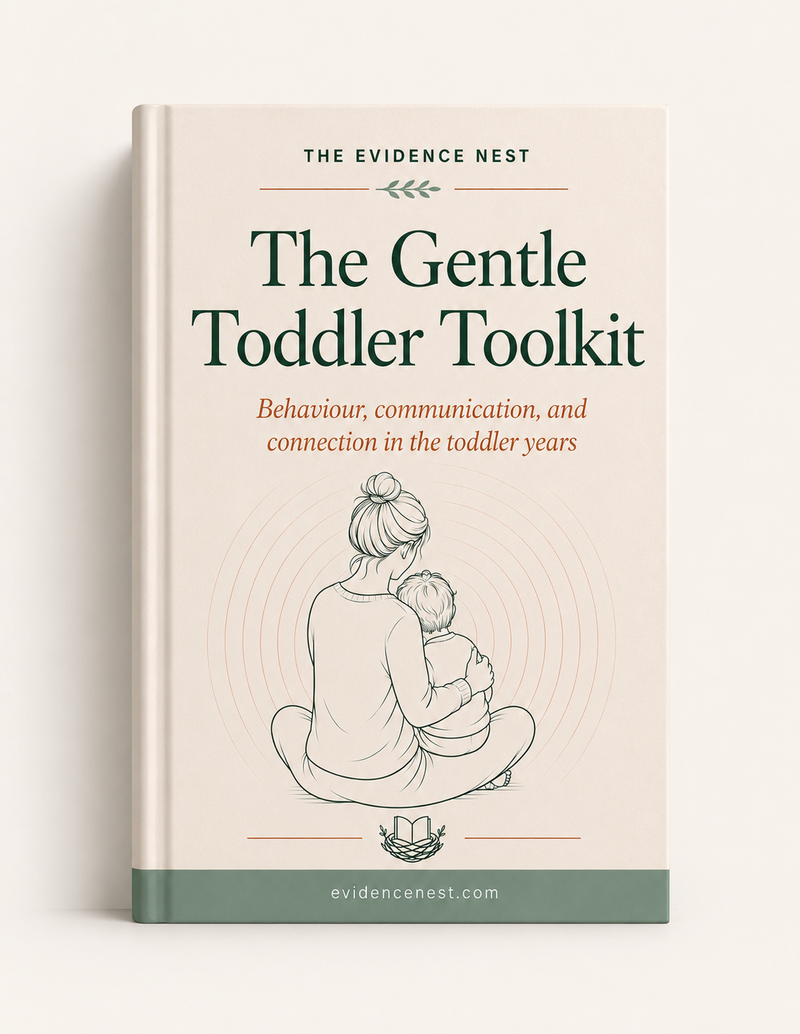
Toddler Behaviour · Ages 18 months–4 years
The Gentle Toddler
Behaviour, communication, and connection in the toddler years
$24.99
What this guide solves
My toddler has meltdowns over nothing and I lose it too. I feel like I'm making it worse.
The guide explains why toddler tantrums are a neurological event, not a behavioural choice, and gives you a five-step de-escalation framework that starts with regulating yourself first — because that's what the evidence says matters most.
I've tried ignoring the tantrums but it doesn't seem to work. What am I missing?
There's a dedicated section on whether ignoring works, what the research actually says about it, and why co-regulation tends to shorten tantrums more reliably than withdrawal.
I don't know what to say in the middle of a meltdown. Everything comes out wrong.
The guide includes parent scripts — specific phrases, with explanations of why each one works — for the most common toddler scenarios, so you have something to reach for in the moment.
My toddler seems so much more intense than other kids. Is something wrong?
Temperament is covered directly. The guide explains the difference between temperament and character, what the research says about highly reactive toddlers, and why intensity at this age is not a sign of future problems.
I feel enormous guilt every time I shout. I don't know how to recover from those moments.
There's a full section on repair — what to do after you lose your cool, how reconnection before redirection works, and why the research on rupture and repair is actually reassuring for parents.
I want to understand what's actually going on in my toddler's brain, not just be told what to do.
The guide opens with the developmental neuroscience: the prefrontal cortex gap, the language-emotion gap, and why toddlers are not being naughty. Understanding the why makes the strategies make sense.
Inside the guide
What Is Actually Happening in That Moment
p. 4
The Myth of the Naughty Toddler
p. 6
What Co-regulation Is (and What It Is Not)
p. 8
The Five-Step De-escalation Framework
p. 10
Age-by-Age: What the Framework Looks Like in Practice
p. 13
Common Scenarios with Specific Strategies
p. 14
Parent Scripts: What to Say and Why
p. 15
What to Do After the Storm Passes
p. 16
Taking Care of Yourself First
p. 18
What the Evidence Does Not Support
p. 19
When to Seek Professional Support
p. 20
Common questions
The guide focuses on emotional outbursts and de-escalation, but covers the full context: why toddler behaviour is what it is, how temperament plays a role, what to do in common scenarios, how to talk to your toddler before and after difficult moments, and how to look after yourself in the process.
The guide is written for children aged 18 months to 4 years, where this type of emotional dysregulation is most intense. Some of the principles — particularly around co-regulation, scripts, and repair — remain relevant beyond that, but the developmental framing is specific to the toddler years.
The guide is grounded in developmental psychology research rather than any parenting philosophy. It draws on the same evidence base that informs connection-first approaches, but focuses on what the research actually supports rather than any particular label or school of thought.
There is a dedicated section on when to seek professional support, with specific indicators that distinguish the normal intensity of toddler development from behaviour that warrants assessment.
The strategies in the guide are designed for the individual parent to use independently. You do not need a perfectly consistent co-parent for them to be effective. The guide does not assume ideal conditions.
About the research
Every claim in this guide is sourced to a peer-reviewed study or clinical guideline. References are listed in full at the end of the guide.