The Evidence Nest
Why Your Baby Stopped Sleeping · $24.99
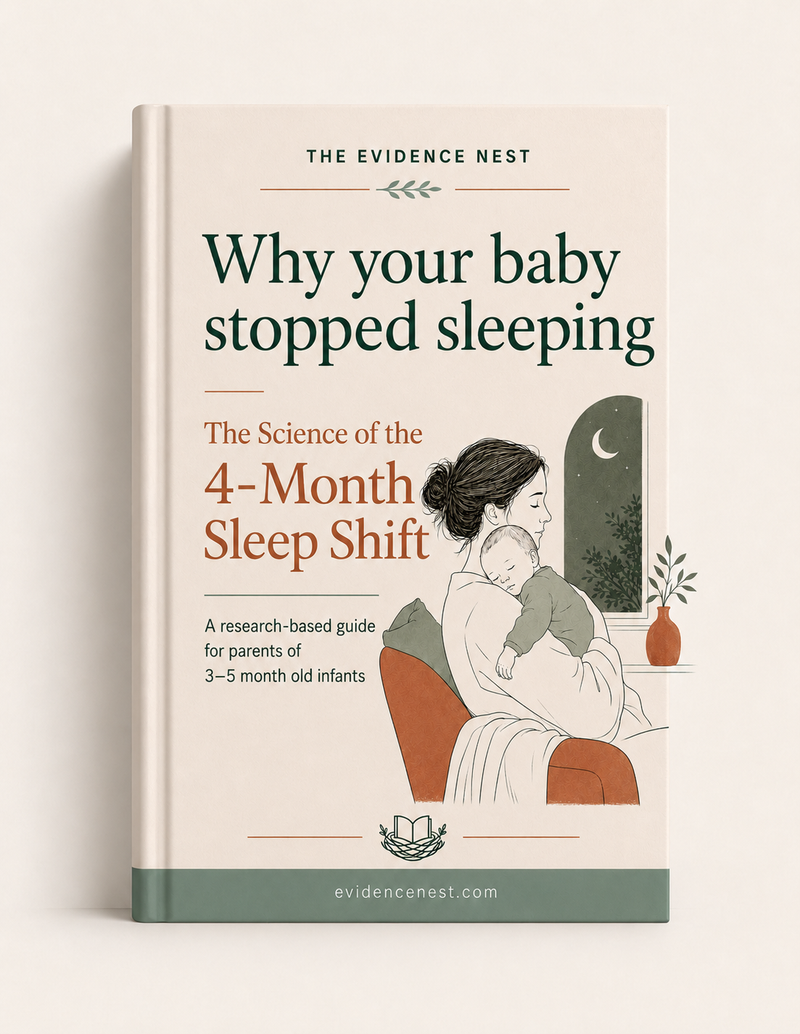
Sleeping · 3-5 months
Why Your Baby Stopped Sleeping
A research-grounded guide to teaching kids about money, saving, and financial habits that last.
$24.99
What this guide solves
My baby was sleeping and now suddenly wakes every hour. I don't know what changed.
Nothing went wrong and nothing you did caused this. Around 3 to 5 months, your baby's sleep permanently reorganises into a multi-stage system. They are now surfacing at the end of each sleep cycle in a way they were not before. The guide explains exactly what shifted and why, so you understand what you are dealing with before deciding what to do about it.
I've read everything and I'm getting completely contradictory advice.
Most advice on this topic describes symptoms without explaining the cause, or recommends one approach without grounding it in evidence. This guide is built on peer-reviewed research and is honest about where evidence is mixed or inconclusive. It gives you what the research actually shows, not what is most commonly repeated.
I don't know whether to sleep train, wait it out, or something in between.
The guide does not tell you what to do. It explains what the evidence supports across the full range of approaches, from responsive settling to gradual independence, and is clear that no single method is universally optimal. Once you understand the mechanism driving the disruption, the decision about what to do becomes yours to make with full information.
My baby is fighting the swaddle and I'm not sure if that's related.
It is directly related. The four-month period coincides with the emergence of rolling attempts and increased arm movement, which means swaddling becomes a safety issue at exactly the same time the sleep architecture is shifting. The guide covers the swaddle transition specifically, including the AAP safety guidance and how to manage the transition without making the sleep disruption worse.
I'm not sure if my baby's overnight feeding is a genuine need or just a habit.
Most infants at three to five months still have a genuine physiological need for overnight feeds, particularly breastfed infants. The guide addresses this honestly, including why the distinction between a feed that follows waking and one that causes waking matters, and why eliminating overnight feeds entirely at four months has no evidence-based justification.
I'm completely depleted and I need to know this is going to end.
The guide includes a dedicated section on parental wellbeing that takes your sleep deprivation seriously rather than treating it as an afterthought. It covers what fragmented sleep actually does to adult cognition and judgement, practical strategies for redistributing the load, and clear guidance on when the difficulty has moved beyond ordinary tiredness and warrants clinical support.
Inside the guide
What Is Actually Happening
p. 4
The Neuroscience of Newborn Sleep
p. 5
What You Are Likely Experiencing
p. 8
What the Research Says About Sleep Associations
p. 10
What You Can Actually Do
p. 12
A Practical Reference: Strategies and What to Expect
p. 16
Parental Wellbeing Is Not Optional
p. 17
Frequently Asked Questions
p. 20
When to Seek Professional Help
p. 22
References
p. 24
Common questions
It is not a regression. Between 3 and 5 months, your baby's sleep permanently reorganises from a simple two-state newborn system into a multi-stage architecture with distinct NREM and REM stages. Your baby is now surfacing at the end of each sleep cycle and noticing when the conditions that were present at sleep onset are no longer there. The guide explains this mechanism in full and what it means for your options.
No. The guide presents what the evidence supports across a range of approaches, from responsive settling to gradual independence, and is explicit that there is no single method the research endorses as universally optimal. It gives you the information to make your own decision based on your baby's temperament, your values, and what is sustainable for your family.
Yes. The architectural shift typically occurs between 3 and 5 months, and some babies experience it closer to 12 weeks. If you are already noticing disruption, the guide is directly relevant. If you are reading ahead, it will help you understand what is coming and why.
The guide is delivered as a PDF and a .docx file immediately after purchase. No app or subscription is required. You can read it on any device or print it.
Most free content on the four-month regression describes symptoms without explaining the underlying neuroscience, or recommends specific approaches without grounding them in research. This guide is built on peer-reviewed sources, explains the mechanism behind the disruption, and presents options honestly, including where the evidence is mixed or inconclusive.
If this guide was not what you needed, reach out within 14 days and we will make it right.
About the research
Every claim in this guide is sourced to a peer-reviewed study or clinical guideline. References are listed in full at the end of the guide.